

News
April 12, 2026
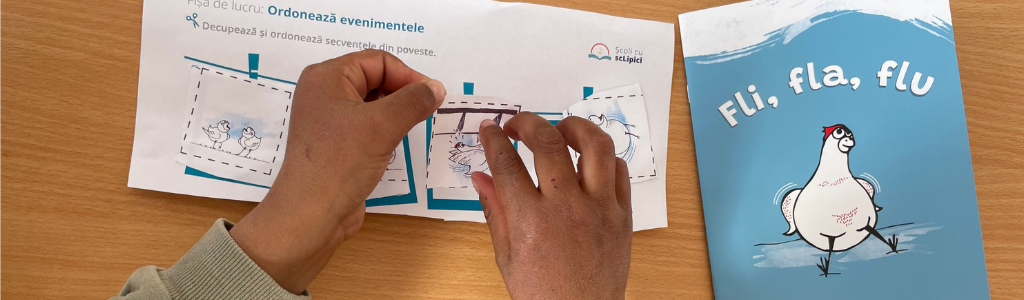
Glittery teachers – resources used and continuous effort
Education does not change only through textbooks or school curricula, but especially through the people in the classroom. Teachers who choose to experiment, adapt, and believe in each child’s potential are the ones who transform the school experience into something meaningful and relevant for every child’s development.
In the “Glittery Schools” program, these teachers become the core of a community that brings more engagement and joy to learning, greater efficiency in teaching reading and writing, and increased interest in reading. The goal is clear: to develop competent and confident readers.
This school year, the program brings together an extended nationwide community: 241 teachers working with 238 classes, totaling 4,242 children in primary education—from preparatory grade to 4th grade.
In the 179 schools involved, across diverse environments and contexts, these educators share not only their role at the classroom level, but also the desire to bring more meaning, engagement, and confidence into the educational process.
Beyond the numbers, however, lie the stories of these teachers—stories of patience, adaptation, and creativity; of challenges and solutions; of lessons that change not only the way a child learns, but also how they see themselves. In a system where change can often feel slow, they are the ones who bring, day by day, that “sparkle” that makes the difference.
And we, through the literacy program, stand alongside these teachers by providing free resources that go directly into children’s hands—literacy kits rich in books and activity sheets.
How do the literacy kits contribute in concrete terms?
Teachers describe these resources as “real support,” which helps cultivate the joy of reading in a natural and engaging way. The illustrated books, worksheets, and teaching guides are used consistently in the classroom, as part of a coherent approach aimed at ensuring that every child learns to read and write by the end of primary school.
The resources from the “Glittery Schools” program are used consistently and in a structured way in the classroom, being regularly integrated into literacy activities. In most cases, teachers work with one book over several weeks, for 1–2 hours per week, alternating reading with activities focused on comprehension and reinforcement of knowledge.
The worksheets are used either immediately after reading or in parallel, often completed in full and revisited whenever clarification is needed. Activities take place both individually and in pairs or groups, and in some contexts the resources are used daily, depending on the pace of the class and the organization of simultaneous teaching.
💡The most appreciated activities are the interactive ones:
- Cut-and-sequence image worksheets — they help develop logical thinking.
- “Drawn vocabulary” exercises — they help children visualize and remember new words.
- Prediction activities (“What do you think will happen?”) — they stimulate curiosity.
- Brainstorming and the question wheel — they encourage children to make connections, even though additional guidance is sometimes needed.
The playful dimension is essential: the activity “Say what you think!”, carried out with the help of a dice, turns reading assessment into an interactive game, while the “Word Pyramid” exercise develops vocabulary and creative expression by progressively building sentences.
The books in the program are close to children’s world and have a visible impact. For example, the book “Who Stole My Shoe?”, from the second-grade literacy kit, captured students’ interest through its element of mystery, while the main character in the book “Sima and Siza” becomes a small hero for readers. Activities are often complemented by pair work or collective reading, which increases engagement and collaboration.
The resources from “Glittery Schools” are appreciated for their practical, interactive, and age-appropriate nature. They contribute not only to the development of literacy skills, but also to creating a warm, motivating learning environment in which children participate with joy and confidence.
An example from the classroom
Teacher Ioana Țiplea, who teaches at Breb Secondary School in Maramureș, in a multi-grade classroom, is an example of commitment and adaptability to students’ learning needs. By consistently using the program’s resources, she succeeds in creating a structured learning environment focused on real progress, tailored to each child’s needs.
Working with the four preschool-level students in her class, she has gone through all the booklets in the package and part of the worksheets, focusing on essential activities such as identifying the initial sound, matching words with images, and recognizing the number of words in a sentence. Pair activities have increased children’s engagement and interest.
Among the students’ favorite materials were the worksheets for “Alma Looks for Numbers,” which naturally combine mathematics and Romanian language communication, as well as the book “Grandfather’s Garden,” which sparked interest in the topic and in drawing-based illustration activities.
📊 Emerging literacy development:
At the end of the school year, we will be able to measure and analyze the real progress made by the four students following the re-administration of the emerging literacy assessment tool.
Every effort counts
These developments show that each child has their own pace, but also that, with careful support and appropriate methods, progress is possible for everyone. And we have many such examples among the 238 “scLipici” classes.
The sustained work on syllable segmentation in the preparatory grade, the constant revisiting of concepts, the attention given to reading and text comprehension, the management of simultaneous differentiated activities within the same classroom, and much more—all of these reflect the quiet perseverance of teachers—that invisible work which, over time, makes a difference.
The openness to new resources and the desire to make lessons more accessible directly contribute to children’s progress. For all teachers, the example from Breb school is a confirmation: every effort counts.
Yes, in a rural school. Yes, in a multi-grade classroom. Even small progress, accumulated over time, becomes visible results.
We are grateful to all the teachers who, with patience and dedication, stand beside each child on this essential journey. Thanks to them, step by step, more and more children learn to read and write with confidence by the end of 4th grade.
The “Glittery Schools” program is funded by Pepco Romania.
The literacy materials used within the program were developed with the financial support of the following partners and donors:
8845 CITESC, Anapan, Asociația Cip și Ciargi, Bianca Balea, Cartea Copiilor, Cătălina Cobîltean, Chargepoint, Corina Farczadi, ERIKS Development Partner Eastern Europe Office, Explora Solutions, Foundever Romania, Geotermal Group, GMC Consinstal SRL, Grădinița UBB, Laura Borbe, Lelia Cecalacean, Maria Kovacs, MedInteractiv Plus, MKOR, OvidiuRO, PartnerHero, Prieteni cu scLipici, Ruxandra & Timea, Sioux Technologies, Sorana Pogăcean, Teo Ola, Tibi Codorean, Triskuel.
We thank everyone for making this work possible.
💡Do you want to bring glitter in your classroom too?
All the educational resources mentioned above are available for free on the page Educational resources – All children read.
Explore them and see what suits you best. Happy reading and keep planting confidence!